
To the General Assembly of the DOSB / Criticism of ‘minimum operational requirements’
In a joint press release, NOlympia Hamburg and the Bund der Steuerzahler Hamburg criticise the DOSB’s ‘minimum operational requirements’ for the Olympic concepts of the applicant cities and regions:
Olympics in Hamburg: Traffic chaos and safety at taxpayers' cost – city minimum requirements not met
Within the framework of the so-called ‘minimum operational requirements’, the DOSB examined the four candidate cities for event feasibility and plausibility of the overall concept.
Hamburg and all other cities have passed. The results will be presented to DOSB members on 6 December. NOlympia Hamburg and the Association of Taxpayers Hamburg e.V. They do not meet their minimum requirements.
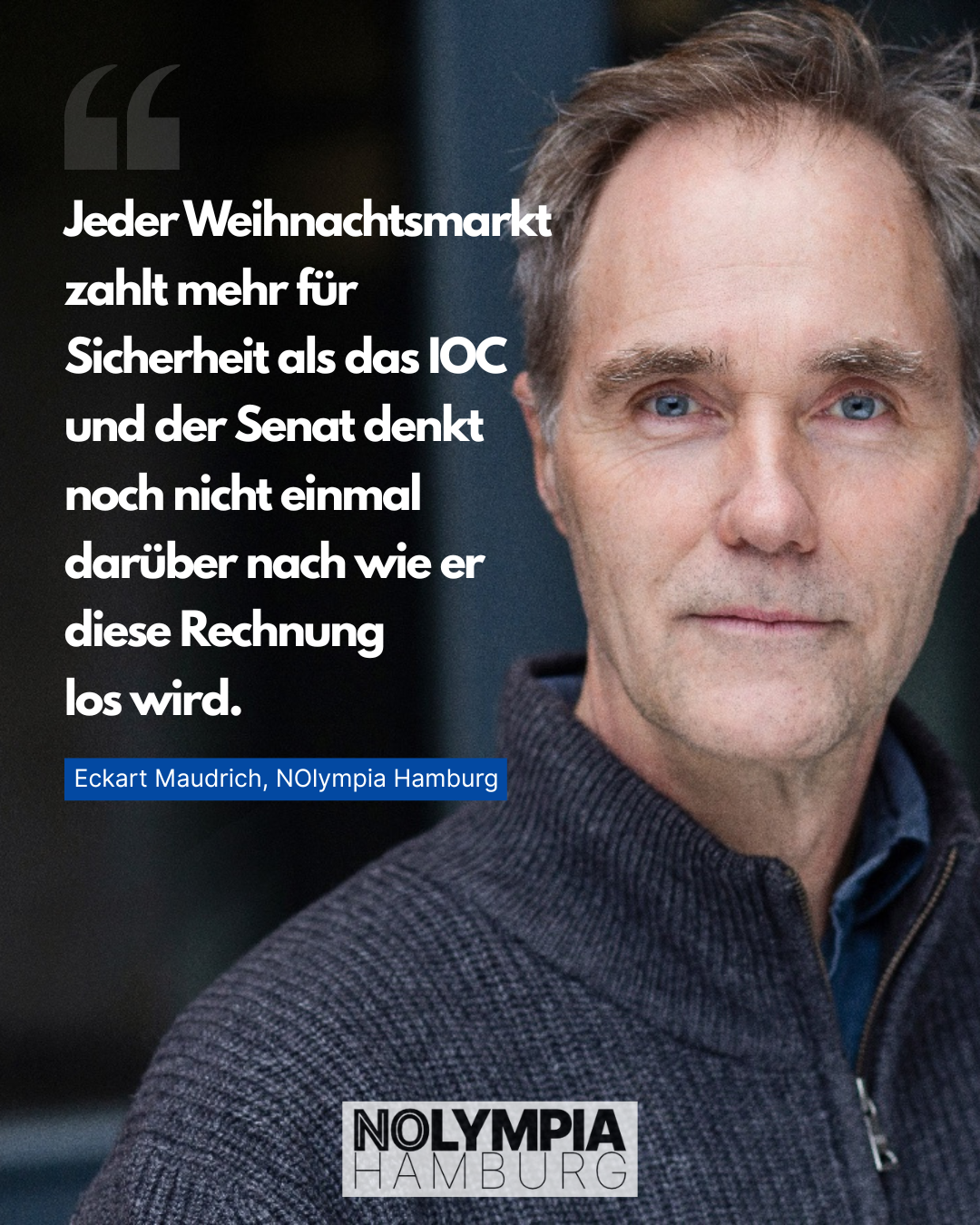
Eckart Maudrich, spokesperson for NOlympia Hamburg: “According to the DOSB’s test method, central Hamburg transport arteries would become needle-eyes for Hamburgers – such as the Elbtunnel, the Elbbrücken, the Lombardsbrücke, as well as the Willy-Brandt-, Budapester-, Stresemann- and Billhorner Brückenstraße. On these roads, own lanes for the IOC as well as accredited ones, so-called Olympic Lanes, would be established. The chaos would be pre-programmed, the city paralyzed. In terms of risk and burden sharing, the Senate also accepts the status quo of the IOC instead of fighting for Hamburg: Christmas market organisers pay for the safety of their event. In the games, however, the city is willing to pay gigantic sums for it – like Paris, where securing the games cost the public budget 1.4 billion. The Senate has not even considered the idea of at least having the high-risk costs paid by the IOC. The fact that this information was not provided in the so-called participation formats speaks volumes.’
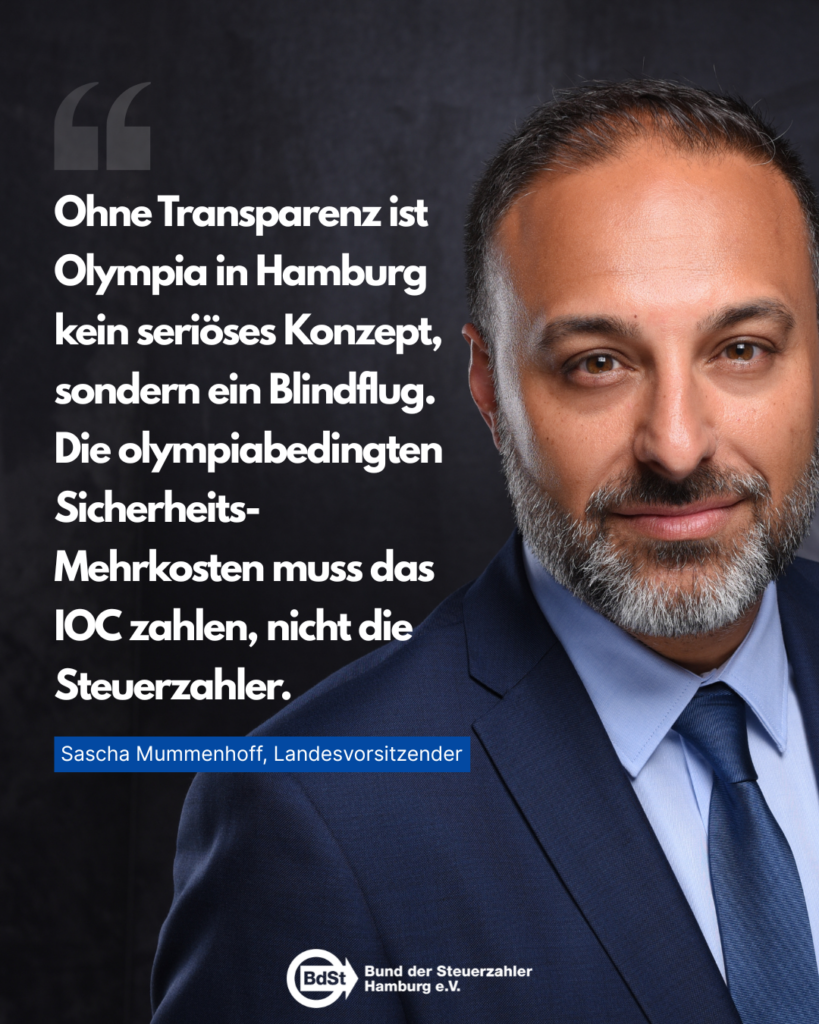
Sascha Mummenhoff, Chairman of the Hamburg Taxpayers Association:
‘The fact that DOSB Hamburg waved through in terms of event suitability does not answer the decisive question: What are the concrete burdens on the city and who ultimately bears the risks and costs, especially in terms of traffic and safety? Without full transparency, a responsible assessment is impossible.
The Federation of Taxpayers Hamburg e.V. therefore expects a complete, publicly accessible cost presentation, from the first euro of the application phase to infrastructure, organizational and security expenditure. Any financial commitment must be transparently disclosed before any political determinations are made.
And, of all things, in terms of security costs, we have been experiencing a wall of silence for years: The Hamburg interior authority denies real transparency about which police costs actually arise at major events and how they are composed. Anyone who wallows in day-to-day business must certainly not take on any additional billion-dollar risks.
In professional football, we have been calling for the polluter pays principle for years: Anyone who initiates additional police operations should bear the additional costs. The same standard must apply to Olympia. It is inconceivable that taxpayers shoulder the Olympic-related additional security costs of a global billion-dollar event, while the IOC benefits economically.
Our position is therefore: The Olympic-related additional safety costs, in particular high-risk and additional expenses, must be covered by the IOC. The Hamburg Senate must keep an eye on the reality of its own budget. If further major projects (natural history museum in Elbtower, Kuehne Opera, renovation of the existing opera, port museum and future decision) are planned in parallel, the obligation of transparency, priorities and clear risk limitation increases. This is not a vote against Olympia. But the Olympics can only be discussed seriously in Hamburg if all the risks are on the table and the taxpayers do not become a self-service shop for an international prestige project.”
 English (UK)
  Deutsch
  العربية
  Dansk
Dansk  Français
  Polski
  Русский
  Türkçe
  Українська
  Español